
INTRODUCTION:
The holiest occasion of Maha Shivaratri coincides with the Aradhana of Sri Vishnutirtha of Madanuru. Sri Vishnutirtha occupies an unique place in the Guru Parampara of Dvaita school of Vedanta. He didn't sit on a great Guru Peetha or traveled extensively to gain name and fame. Yet the stature of Madanuru Sri Vishnutirtha is unparalleled.
This small write-up introduces the readers to an important message given by Sri Vishnutirtha in his magnum opus Bhagavata Saroddhara.
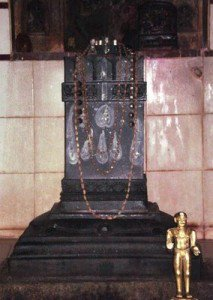
BRIEF BIOGRAPHY OF SRI VISHNUTIRTHA
Sri Vishnutirtha was born in the year c.1756 as Jayatirthacharya and entered brindavana in c.1816. He was a man of many riches in his gRuhastha life.
The legend of Sri Vishnutirtha says that one day he was enjoying siesta by munching beetle-leaf given by his beautiful wife. He was sleeping in a swing made with ivory. Then he heard a mendicant passing through the street singing - "Wife won't be coming with you - your cozy cot won't come with you - None of your riches come with you once you are gone - So, gain some Dharma before you leave [this world]"
These words caused a deep inner commotion in Jayatirthacharya. He suddenly rose from the ivory swing and left the home. He approached Sri Satyavara Tirtha of Uttaradi Matha and sough Sanyasa Diksha. By looking at the ripened Vairagya of Jayatirthacharya Sri Satyavara Tirtha gave him the Deeksha. Thus, at the age of 40, Jayatirthacharya became Vishnutirtha.
Subsequently, Sri Vishnutirtha continued his advanced studies under the tutelage of another great saint of those times - Sri Vyasatattvagna Tirtha of Iiji.
After becoming Sanyasin, Sri Vishnutirtha never entered in to a town but remained in the woods. Hence people started addressing him as "Aranyakacharya" or "Adavi Acharya" i.e. Master of the Woods.
As a saint, he was not attached to any Matha but remained as an independent ascetic.
SRI VISHNUTIRTHA AS A PROLIFIC WRITER
Sri Vishnutirtha is known as an author of some excellent works on Dvaita philosophy. He wrote 20 treatises and each of them is a gem of its kind. Most of his writings are tough-nuts to crack not just for laymen but to the learned ones as well. Particularly, the works titled Shodashi and Chaturdashi are considered as the pivotal works by Sri Vishnutirtha of Madanuru.
Among all his works "Bhagavata Saroddhara" has a special place.
BHAGAVATA SARODDHARA
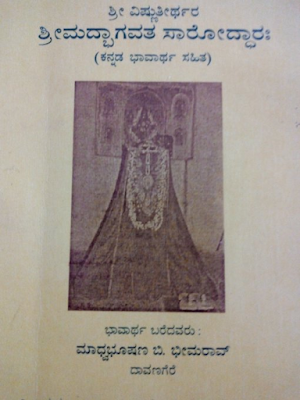
Bhagavata Saroddhara is an abridged version of Srimad Bhagavata. In 367 shlokas, Sri Vishnutirtha offers the teachings of Bhagavata that Sri Vedavyasa explained in 18,000 shlokas.
Sri Vishnutirtha identified that Bhagavata teaches 30 essential Dharmas that the Sadhakas must adopt in their Sadhana. These 30 Dharmas are explained in 367 shlokas.Hence "Bhagavata Saroddhara" is also a kind of Dharma Shastra written for the benefit of Dharmikas to brave the attacks by Kali & his followers.
On the holy ocassions of Maha Shivaratri and Aradhana of Sri Madanuru Vishnutirtha, let us briefly go through one essential Bhagavata Dharma taught by Sri Vishnutirtha by extracting the lesson from Daksha Yagna episode. Sri Vishnutirtha named this dharma as "Mahanninda Varjana Prakarana" [mahat+nindA+varjanaM]
MAHANNINDA VARJANA PRAKARANA
This particular dharma is about the avoidance of insulting great souls and is very important to learn and practice, says Sri Vishnutirtha. He advises that Daksha is the best example to understand the consequences of "mahat nindA" [insulting the great ones].
In 8th chapter of Bhagavata Saroddhara, Sri Vishnutirtha subtly touches upon Daksha yagna episode wherein Daksha intentionally insults his own daughter Satidevi who is the divine consort of Mahadeva. This Daksha, subsequently, performs a 'nirIshwara yagna' i.e. yagna w/o offerings given to Mahashiva.
Under the title "Mahanninda Varjana," Sri Vishnutirtha describes a debate that took place between Sati devi and Maha Rudra. This dialogue is woven skillfully with various threads of Dharma & Adharma aspects. The divine couple of Sati and Shiva argue and counter argue about what is right and what is wrong. In this chapter, Sri Vishnutirtha also narrates the discussion held between Rahogana and Jada Bharata.
From the explanation given by Sri Vishtirtha, it can be inferred that Daksha whose name means 'diligent' or 'clever' indulged in an unintelligent act of insulting Mahashiva who is much superior to him in power, knowledge & divinity. As a result Daksha, the capable one, lost his head i.e. righteous knowledge.
Thereafter, he was destined to live with a goat's head. It is no great discovery to know that the brain power of a goat is much inferior to a human. Similarly, Daksha lost his head due to intentional insult meted to a great being i.e. Maha Shiva.
By Sri Vishnutirtha advises, one must always respect the knowledgeble persons even if they are looking like a child or younger in physical appearance. He says that wise men always look like a kindle of fire covered with ash & hence one must be careful to deal with them.
Sri Vishnutirtha concludes "mahannindA varjana" chapter with this shloka.
नमो महद्भोस्तु नमः शिशुभो-नमो युवभ्यो नमो अबटुभ्यः
ये ब्राह्म्णा गामवधूतलिंगा-श्चरंति तेभ्यः शिवमस्तुराज्ञां
"I prostate before avadhUtA-s even if they show-up as infant, child or younger to me."
CONCLUSION:
On this Shivaratri, let Parvatipati Maharudra and Sri Vishnutirtha of Madanuru bestow us with virtuous quality of "mahatsEvA bhAgya" [service to great souls] instead of "mahannindA daurbhAgya" [insulting the great souls].
||namaH pArvatIpatayE hara hara mahAdEva||
Comments
Post a Comment